# Architecture
Source: https://docs.privacytracker.privacykey.org/develop/architecture
Codebase shape, data flow, three crash-safe runners, and the database model.
A Next.js 16 App Router app, written in TypeScript, backed by a single local SQLite file. All scraping, parsing, AI calls, and snapshotting happen server-side inside API routes that import helpers from `lib/`. Tauri wraps the same frontend as a desktop app, and Docker ships it as a self-hosted service. The server side has two implementations while the Node server is the rollback: `lib/` behind the Next.js API routes, and `core/`, a Rust port that answers the same API byte for byte. The Docker image runs `core/` (`pt-core serve`), and so does the desktop app from its first release on the Rust backend.
> **Note**
>
> This page is the "where do I look?" layer. The dense, byte-level engineering reference is in `AGENTS.md` and `CLAUDE.md` at the repo root — coding agents read those directly.
## Three distribution surfaces, one bundle
```mermaid
flowchart LR
src[npm run build]
src --> tauri[Tauri shell
Apple Silicon + Intel
signed .dmg]
src --> docker[Docker image
Linux / NAS]
src --> brew[Homebrew cask
same .app bundle]
tauri --> upd[Tauri updater
ed25519 verified]
docker --> manual[Manual
docker compose pull]
brew --> brewup[brew upgrade --cask]
```
The same Next.js build drives all three. The Docker image serves it with the Rust server, `pt-core serve`; earlier images, v0.1.2's included, run Next.js's standalone bundle under Node instead. Homebrew installs the same `.app` bundle as the desktop release. The desktop app runs the standalone bundle as a sidecar Node process on releases before the Rust backend, and from the first release on it serves the same built frontend from the same Rust server, compiled into the app: see [Tauri & the backend](https://docs.privacytracker.privacykey.org/develop/tauri).
## Shape of the codebase
```
privacytracker/
├── app/ Next.js App Router pages + API routes
│ ├── api/ thin wrappers over lib/*
│ ├── components/ large client components (OnboardWizard, SettingsView, AppDetailView, AppGrid, TaskCenter…)
│ ├── dashboard/ server pages that hand off to client components
│ ├── onboard/ audience picker → import wizard
│ ├── apps/[id]/ app detail + change history
│ └── globals.css design tokens, severity colours, .legal-layout primitives
├── lib/ server-side logic — most of the product lives here
├── core/ the Rust server (pt-core): the same API, run by the Docker image and the desktop app
├── src-tauri/ Rust desktop shell + sidecar lifecycle
├── scripts/ out-of-band scripts (ios-app-import companion, screenshot capture, standalone staging)
├── deploy/ reference reverse-proxy stacks (caddy/, traefik/)
├── tests/ node:test suites + Playwright specs
├── locales/ en.json / zh.json translation bundles
├── public/ static assets served by Next
├── docs/ in-repo notes (the published site lives in docs-privacytracker)
├── data/privacy.db SQLite database (gitignored; in Docker, a Docker-managed volume)
└── AGENTS.md / CLAUDE.md coding-agent instructions
```
The cask formula is **not** in this repo — it lives in [privacykey/homebrew-tap](https://github.com/privacykey/homebrew-tap) at `Casks/privacytracker.rb`, regenerated by the release workflow on every tag.
## Core data flow
One scrape, one pass through the seven-step loop:
```mermaid
sequenceDiagram
autonumber
participant U as User / scheduler
participant API as POST /api/scrape
participant scraper as lib/scraper.ts
participant Apple as apps.apple.com
participant DB as SQLite
participant cl as lib/changelog.ts
participant pol as lib/privacy-policy.ts
participant AI as AI provider
U->>API: trigger scrape (URL list)
API->>scraper: fetchAndParseApp(url)
scraper->>Apple: GET App Store HTML
Apple-->>scraper: serialized-server-data JSON
scraper->>scraper: walk shelf fallback chain
scraper->>cl: capture previousSnapshot
scraper->>DB: saveToDb (apps → privacy_types → privacy_categories)
scraper->>cl: buildSnapshot + diff
cl->>DB: persist snapshot + change list
cl->>DB: bump apps.changeCount
cl->>DB: insert notification row
Note over pol,AI: only if AI configured + policy hash changed
pol->>Apple: GET privacy policy URL
pol->>AI: summarise per lens (chunked if needed)
AI-->>pol: summary_json
pol->>DB: persist policy_versions row
```
The two patterns to internalise:
- **Capture `previousSnapshot` *before* `saveToDb`.** `saveToDb` wipes and re-inserts `privacy_types` for the app inside a transaction, so capturing after gives you an empty baseline and the diff loses every row.
- **Apple's payload may unwrap two ways.** Always use `Array.isArray(raw) ? raw : raw.data` — Apple ships `{ data: [...], userTokenHash }` sometimes and a bare array other times.
Re-syncs run the same path with `resync=true` — that's what produces change notifications.
The policy step writes a `privacy_snapshots` row to the History timeline on every fetch, through `appendPolicyChangeEntry` in `lib/changelog.ts`. Only a `changed` event can carry `changes_detected = 1` (the column behind the grid's pending dot, the review panel, triage, the universal changelog and the stats) and raise a notification, and only while `flag.notifications.types.policy_updates` is on. It's off by default. `first`, `same` and `error` events are timeline-only, and an unusable body never replaces the stored hash or text.
That notification goes through `createNotification` in `lib/notifications.ts`, which inserts the row and then calls `fireWebhookIfConfigured` for the immediate webhook. App Store changes (privacy labels, accessibility labels, age rating) take a different path to the same call: `commitScrapedAppToDb` in `lib/scraper.ts` writes their bell row in the same commit as the snapshot and calls `fireWebhookIfConfigured` once that commit has landed. Both posts are fire-and-forget, and quiet hours defer only the bell row (`not_before`), never the post. The daily and weekly summaries read the 50 most recent `notifications` rows raised since the previous summary (`maybePostSummaryWebhook` in `lib/notification-webhooks.ts`).
## The shelf fallback chain
```mermaid
flowchart TD
start([App Store HTML]) --> a{shelfMapping.
privacyTypes.items?}
a -- yes --> use1[parse modern shape]
a -- no --> b{privacyHeader.
seeAllAction.
pageData.shelves?}
b -- yes --> use2[parse legacy purposes →
categories, flatten]
b -- no --> c{generic
pageData.shelves?}
c -- yes --> use3[parse generic shelves]
c -- no --> d{shoebox-media-api-
cache-apps script?
(Jan 2021 – Nov 2025)}
d -- yes --> use4[parse Ember/FastBoot
shoebox shape]
d -- no --> bail[log + skip]
use1 --> done([persist])
use2 --> done
use3 --> done
use4 --> done
```
If labels suddenly stop appearing, the first suspect is this chain in `saveToDb` — Apple has shipped breaking shape changes several times. The fourth fallback (`extractFromShoebox`) is what lets the Wayback importer reach back to Q1 2021 captures, where the modern `serialized-server-data` script tag didn't exist yet but the same privacy data lived inside a FastBoot shoebox at `d[0].attributes.privacy.privacyTypes`.
## Three runners that all crash-safely resume
Three bulk operations share one pattern: live App Store sync, Wayback historical import, and policy sync.
| Runner | State module | Mutex key | State blob |
|---|---|---|---|
| App Store sync | `lib/sync-bulk-runner.ts` | `sync_running` | `sync_bulk_state` |
| Wayback import | `lib/wayback-bulk-runner.ts` | `wayback_import_running` | `wayback_bulk_state` |
| Policy sync | `lib/policy-bulk-runner.ts` | `policy_sync_running` | `policy_bulk_state` |
Each runner persists its queue + per-app state at every app boundary, so a process kill loses at most one app's worth of work.
```mermaid
sequenceDiagram
autonumber
participant boot as instrumentation.ts
(boot)
participant DB as SQLite
participant runner as bulk runner
participant UI as TaskCenter
boot->>DB: read sync_bulk_state (8s)
boot->>DB: read wayback_bulk_state (10s)
boot->>DB: read policy_bulk_state (12s)
alt nothing pending
boot-->>boot: no-op
else mutex held but no queue
boot->>DB: clear stale mutex
boot->>DB: insert *_stale_cleared notification
else queue pending
boot->>DB: insert resume notification
boot->>DB: insert "Sync resumed" activity row
boot->>runner: spawn(initiator: 'resume', resumeState)
loop each app in queue
runner->>DB: rewrite state blob
runner->>runner: process app
end
runner->>DB: clear state + mutex (clean exit)
end
UI->>UI: poll /api/tasks/active every 4s
UI-->>UI: render "Resumed after restart" cards
```
`GET /api/tasks/active` returns a unified `{ wayback, sync, policy }` snapshot. Manual runs are filtered out client-side because their starter UI already owns the progress card; resume cards are keyed by `runId` so a new resume cycle replaces the old card cleanly.
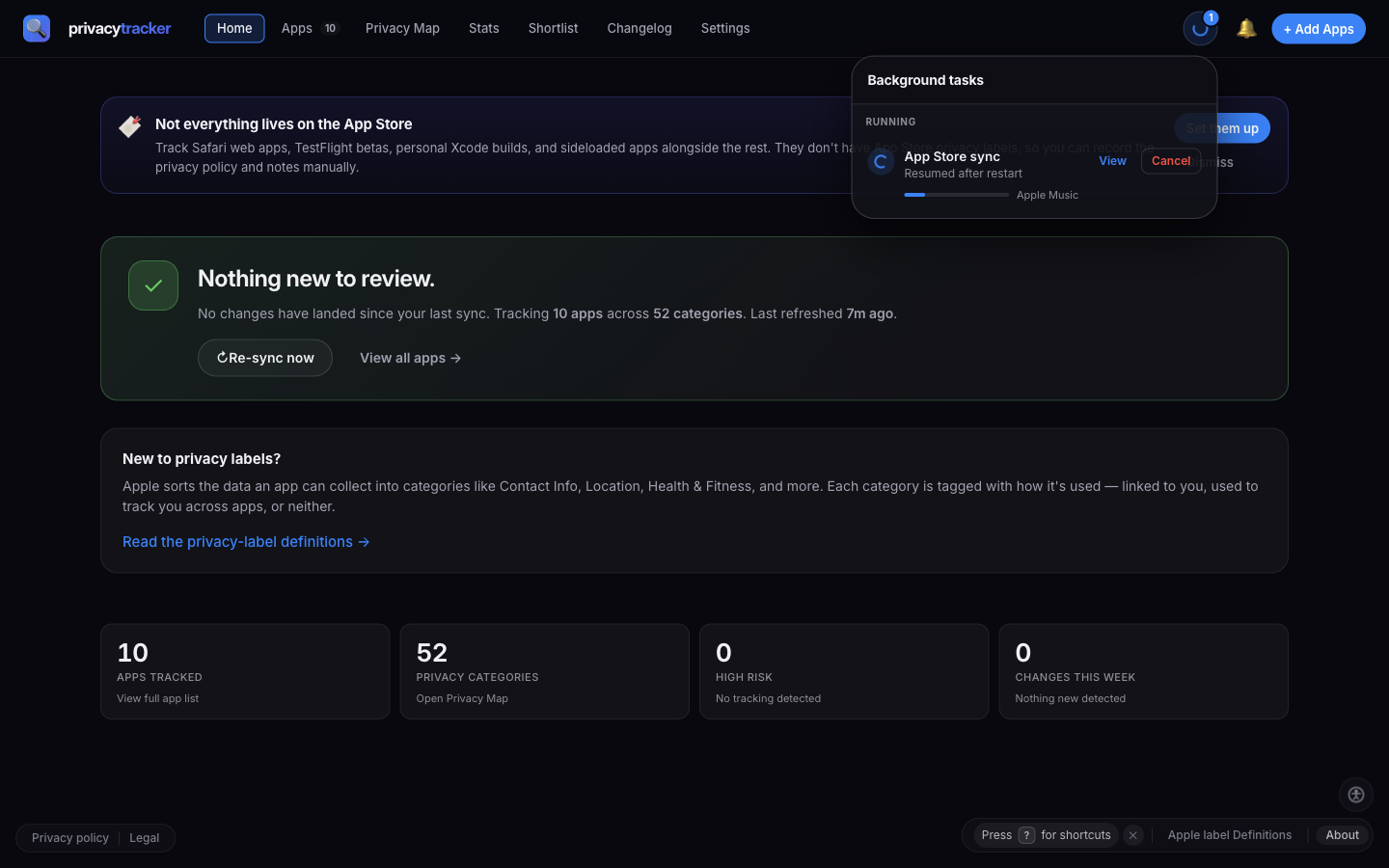
*TaskCenter rendering a resumed background sync*
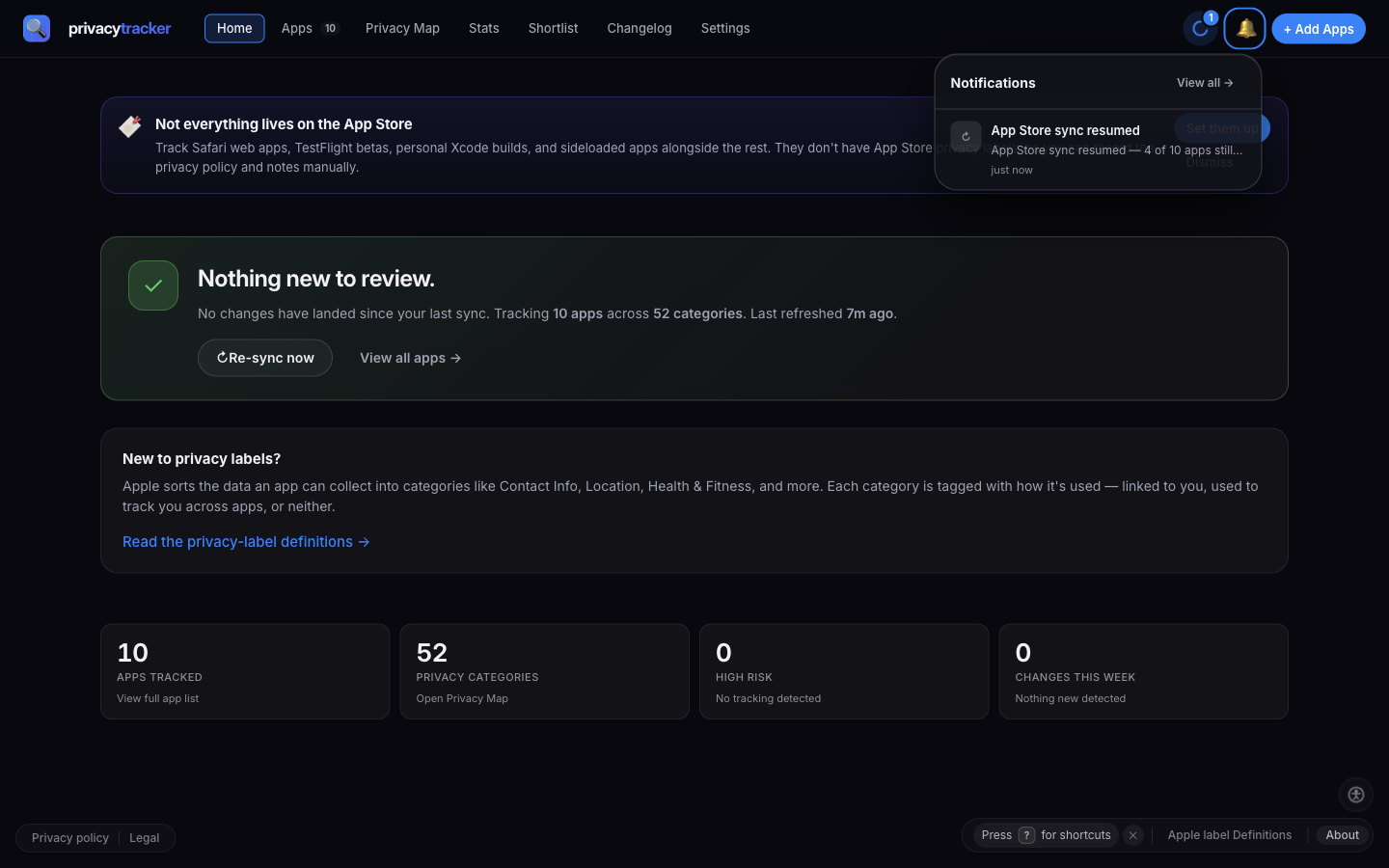
*Resume notification shown in the bell*
### A note on 429s
Apple's 429 handling is deliberately different from a process kill. The runner bails out of the loop on the first 429, records a `partial` activity row with `rateLimited` totals, and **clears state + mutex cleanly** so the next scheduled tick (30 minutes away) can retry fresh. 429 is a recoverable, expected condition — not a crash.
## Database
`lib/db.ts` exports a **singleton** better-sqlite3 instance. Pragmas set on open: `journal_mode = WAL`, `busy_timeout = 5000`, `foreign_keys = ON`. Path defaults to `/data/privacy.db` and is overridden by `PRIVACYTRACKER_DATA_DIR`, which the Tauri shell injects to point at the OS app-data directory — see [Configuration](https://docs.privacytracker.privacykey.org/configuration#environment-variables). Created on demand, data dir at mode `0700` and the DB itself at `0600`. During the Next.js build phase the path is `:memory:` instead.
Schema is owned by two things in `lib/db.ts`:
1. `CREATE TABLE IF NOT EXISTS` blocks for fresh installs.
2. An inline `migrations` array of `ALTER TABLE` statements run on every open for existing installs.
> **Warning**
>
> Any new column must be added in **both** places, or existing installs break.
All DB calls are **synchronous**. Multi-step writes use `db.transaction(() => { … })()` (see `saveToDb` in `lib/scraper.ts`). `better-sqlite3` is declared in top-level `serverExternalPackages` in `next.config.js` — keep it there so Next doesn't try to bundle it.
## API surface
Each route under `app/api/*/route.ts` is a thin wrapper over `lib/`. Routes that read mutable state need `export const dynamic = 'force-dynamic'`. The full route map and the interactive playground are in the [API Reference](https://docs.privacytracker.privacykey.org/api-reference/introduction).
Public contract (request/response shapes) is stable — keep it that way. Destructive routes (`POST /api/reset`, `DELETE /api/apps`, `POST /api/settings`) are gated by a same-origin CSRF check and an optional shared-secret header (`X-Auditor-Admin-Token`) verified with `crypto.timingSafeEqual`. Failed attempts are recorded in `audit_log` with IP + user agent.
## Privacy-profile presets
A privacy profile is a sparse map from App Store category (`LOCATION`, `HEALTH_AND_FITNESS`, …) to the worst data-use tier the user will tolerate (`not_collected` < `not_linked` < `linked` < `tracking`). An app collecting strictly worse than the user's tolerance counts as a mismatch. To make profiles approachable, the editor surfaces four named whole-profile shortcuts above the per-category strip, in both onboarding and Settings.
| Preset | Stance | What it does |
|---|---|---|
| **Strict** | Most restrictive | Most categories sit at `not_collected` or `not_linked`. Many mainstream apps will mismatch. |
| **Balanced** | Sensible default | Identical to `DEFAULT_PROFILE` — strict on health, sensitive, and contacts; lenient on usage and diagnostics. |
| **Anti-tracking only** | One red line | Every category at `linked`. Only third-party tracking flags. |
| **Permissive** | Mostly anything | Most categories at `tracking`, but health, financial, location pulled to `linked` and sensitive info to `not_linked` so the profile is still meaningfully different from "no profile". |
> **Note**
>
> Every preset is **complete**: it covers all 14 categories from `PROFILE_CATEGORY_KEYS`. This guarantees that applying one produces a deterministic profile and that `matchPreset(profile)` can round-trip the choice back to the active pill. A single per-row edit drops the highlight, signalling "this is now custom".
The data and helpers live in `lib/privacy-profile.ts`:
- `PROFILE_PRESET_KEYS` — the canonical render order: `strict`, `balanced`, `anti_tracking`, `permissive`.
- `PROFILE_PRESETS` — the full tier map for each preset.
- `PROFILE_PRESET_META` — label, icon, and `severityCls` so the active-pill accent walks the green → yellow → orange → red gradient.
- `matchPreset(profile)` — returns the matching preset key or `null`.
`PROFILE_PRESETS.balanced` is locked to `DEFAULT_PROFILE` by reference (`{ ...DEFAULT_PROFILE }`), and `tests/app/profile-presets.test.ts` pins the equality.
> **Warning**
>
> If you change `DEFAULT_PROFILE` you change the Balanced preset. That's intentional, but note that returning users currently sitting on the Balanced highlight will silently migrate to the new tier set. Communicate the change in release notes if it's user-visible.
### Overwrite confirmation
`PrivacyProfileEditor` takes an optional `confirmOnPresetApply` prop (default `true`). When the local state is non-empty and doesn't already match the clicked preset, an inline confirm bubble appears under the pill before overwriting — the only place a preset can wipe user customisations.
- **`PrivacyProfileSetup`** (the onboarding screen) sets it to `hasExistingProfile`, so first-time users — whose editor state is just a preloaded `DEFAULT_PROFILE` — explore presets without nag confirms. Returning users get the safety prompt.
- **`SettingsView`** keeps the default `true`.
### Adding a new preset
1. Append the key to `PROFILE_PRESET_KEYS`.
2. Add a complete tier map under `PROFILE_PRESETS`.
3. Add meta under `PROFILE_PRESET_META` (pick a `severityCls` so the active-pill accent fits the gradient).
4. Add `labels.` and `descriptions.` strings under `settings.profile_editor.presets` in `locales/en.json`. Crowdin handles the other locales — see [Translations](https://docs.privacytracker.privacykey.org/develop/translations).
5. Extend the asserts in `tests/app/profile-presets.test.ts` if the new preset has invariants worth pinning (e.g. "must keep `SENSITIVE_INFO` at `not_collected`").
### Carried into audit bundles
When the recommender exports an audit bundle with their profile included, `buildAuditBundle` also calls `matchPreset(profile)` and emits the result as `recommender_profile_preset` (`'strict' | 'balanced' | 'anti_tracking' | 'permissive' | null`). The field is optional, so older `BUNDLE_VERSION = 2` readers keep working unchanged — no version bump is needed. On the loved-one's side, `AuditBundleImport.tsx` reads the field through `ImportSummary.recommenderProfilePreset` and renders *"Recommender used the Strict preset"* in both the preview modal and the post-import banner, reusing the existing `settings.profile_editor.presets.labels.*` strings instead of maintaining a parallel translation set. The preset key is also stashed alongside the raw profile in `app_settings.recommender_profile_suggestion` so any future "preview + accept the recommender's profile" UI can pick it up without recomputing.
### Recorded in the activity log
`PUT /api/privacy-profile` records a `profile_preset_applied` activity row whenever a save crosses a preset boundary — picking a preset, switching presets, or clearing a profile that previously had preferences. Custom-to-custom edits (single-row tweaks inside a non-preset state) intentionally don't fire; the activity log is for noteworthy state transitions, not the editor's debounced keystrokes.
The pure helper `describePresetTransition(old, new)` in `lib/privacy-profile.ts` is the single source of truth for when to write a row and what to attach. It returns either `null` (no transition worth logging) or `{ summary, detail: { from, to, cleared? } }`. Decision rules, in order:
> **Note**
>
> 1. Old had preferences, new is empty → `"Privacy profile cleared"` with `cleared: true`.
> 2. New matches a preset, and that preset differs from the old's match (which may be `null`) → `"Privacy profile changed to {Label}"`.
> 3. Anything else (re-save of the same preset, custom-to-custom edits, no-op) → `null`, no row written.
The activity row's `detail` blob carries the typed transition (`from: ProfilePresetKey | null, to: ProfilePresetKey | null, cleared?: true`) so the feed can render "*Strict* → *Anti-tracking only*" without re-running `matchPreset`.
## What commonly trips people up
- The App Store page parser depends on Apple's HTML. If labels suddenly stop appearing, check the shelf fallback chain in `saveToDb` first, then the privacy-policy link regex (which must handle both straight `'` and curly `'` apostrophes in the "Developer's Privacy Policy" aria-label).
- `apps.id` is the numeric Apple track ID extracted from `/id(\d+)` in the URL — not a UUID. Snapshots, privacy rows, and notifications all key off it.
- When adding new privacy fields, capture `previousSnapshot` *before* calling `saveToDb`, mirroring the existing flow.